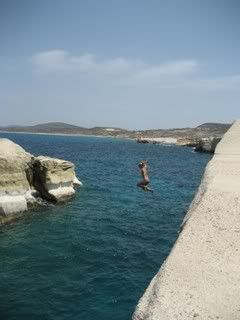
Well, those last three weeks disappeared in front of my eyes! I was so busy, trying to get everything all wrapped up before I flew home...PLUS, my mom came to visit! We spent a week traveling around the Eastern part of Ghana, which is beautiful - very lush, breathtaking waterfalls, and a very peaceful, quiet contrast to the bustle of Elmina. I flew back to California yesterday, so I'm typing up this blog from home -- I wrote it in Ghana but ran out of time to go to an internet cafe!
When I returned to Elmina with only a week remaining, I wondered how I would possibly get everything done -- especially when it came to meeting with a long list of people. The process of getting a message to someone in Ghana is a tad different than here in the US...let me explain. Normally, if I needed to meet with someone, the first variable to consider if they have a phone. Most of the administrators and people in important positions have phones, but most of the students or parents that I needed to contact do not. Assuming they had a phone, I'd call them up, and the conversation would go something like this:
Contact: Hello?
SHawna: Good morning, this is Shawna!
Contact: Oh, good morning! How are you? How is everything?
Shawna: I'm fine, thank you. How are you?
Contact: I am also fine. How are you finding Ghana?
Shawna: It's very nice, thank you. I am hoping we--
Contact: How is your mother.
Shawna: She is fine, thank you. Now I want to know if--
Contact: This is Janet?
Shawna: No, this is SHAW-NA.
Contact: OH! Sorry-o. Good morning! How are you and how is everything?
(repeat entire above conversation)
Shawna: Now, I was wonderi--
Contact: And how are the children? Are they learning hard?
Shawna: Yes, everyone at the school is fine.
Contact: Oh, good. By God's grace.
Shawna: Yes. Ok. So I would like to meet with you to discuss the school.
Contact: Yes, I will be happy to meet with you.
Shawna: Can you meet today?
Contact: Unless tomorrow.
Shawna: Ok, tomorrow. Where can we meet?
Contact: I will find you.
Shawna: Creepy, but okay. See you tomorrow.
Skip to "tomorrow," when the contact would show up wherever I was -- be that the school, in town buying some spring rolls, taking a walk...somehow the person would know my exact whereabouts at all times. This is a result of the "drum line." Some of you, who have lived on islands, may be familiar with this concept as the "coconut wireless." In any case, it's the fact that everyone knows everything that everyone is doing exactly 2.5 seconds after they've done it, sometimes sooner. SOMETIMES, actually, they could predict my actions - like one incident when I had a lull in my day and took the opportunity to flag down a share-taxi to go to the post office. About halfway there, the cab driver pulled over at some random dirt road along the way, honked, causing a familiar face to peer out of a mud hut, smile, wave, and then approach the cab and say "I heard you would go to the Post office today. May I escort you?" I understand that HE heard about my plans for the day, that's easy enough to follow, but did this mean that EVERY possible cab driver (and that's a LOT of drivers) ALSO knew?
Once I had actually made contact with the person I was supposed to see, I inevitably had to set up another appointment for the following day, because it usually took between three and five meetings to actually discuss what I had called the meeting for in the first place.
Remember, this was assuming the person had a phone. If they did not, I would simply try to locate a family member or good friend, and ask them to spread the word that I was looking for, say, Joseph, which usually resulted in Joseph finding me within an hour or two. If I knew that "Joseph" was in a certain general vicinity, I wouldn't bother looking for friends or family, I'd just go to that part of town, and begin informing anyone I saw that I was looking for him, and then, after a sufficient number had been dispatched (5 or 6 was usually enough), I'd sit myself down somewhere and wait for Joseph to come jogging up to me fifteen minutes later. If I didn't know where to start (ie, couldn't find friends or family, and didn't know their location) I'd just bring up my quest in every single conversation that I had all day long, and somehow word would spread to an adjacent village and then to the next town and then by carrier pigeon or small child relay team or something to the house two hours away where Joseph was visiting his mother's sister's husband's friend (aka his "brother"). Then Joseph would either dispatch the messenger crickets to click out a message that would be delivered to me an impossibly quick fifteen minutes later, or he would cut his visit short and unexpectedly show up at my side, interrupting the conversation that I was still having about his whereabouts.
It really was an incredibly efficient system.
Well, unfortunately, the adventure has come to an end. When I look over these stories, I realize what an incomplete picture they paint...but I suppose I can't expect to describe it all (though I would like to). There are so many stories left untold...daily cultural nuances left unshared. Some of them seemed so minute in comparison to some of the larger conceptual differences, that I didn't even think about describing them here, but now, as usually happens upon returning home, I'm being confronted with them again one-by-one. For example, I'm sure it will take me a while to readjust to "normal" English again - just today I was happy to note that when said that I would be "running" in the morning, no one handed me anti-diarrheals.
Thanks again to all of you for your support, monetary or otherwise -- all of the words of encouragement were priceless and the random emails from home meant the world to me! In the next few days, I'll post a few last pictures, because I finally have a fast connection again!! I want to wish everyone a very happy holiday season, and good luck in the New Year!!!
Stay tuned for the next adventure... :-)
Thursday, December 20, 2007

Tuesday, November 27, 2007
PICTURES!
Since the computers seem to be on my side right now, some pictures!

Some girls goofing around at the school.

The oldest students, studying during night classes.

I went to a track meet for the high school (where some of our students are on scholarship). See the "track" in the foreground? The thing that really made me do a double take was when, during the 4x100 relay, I realized that only half of the guys were wearing shoes!!!

This is the market in Kumasi, which is Ghana's other large city, besides the capital. I got lost under that sea of corrugated tin for around three hours, because I like that kind of thing. I swear, it was on purpose, I meant to lose myself in the market. Just maybe not for three hours...

Back in Elmina...I see this scene every time I walk by this house, on the main road to town. Everyone is crowded around that window because there is a tv in there. In case you're wondering what fascinating show is on, it was a commercial for American WWF Wrestling. YEAH. Imagine the scene when something that people really care about, like soccer, is airing.

Some girls goofing around at the school.

The oldest students, studying during night classes.

I went to a track meet for the high school (where some of our students are on scholarship). See the "track" in the foreground? The thing that really made me do a double take was when, during the 4x100 relay, I realized that only half of the guys were wearing shoes!!!

This is the market in Kumasi, which is Ghana's other large city, besides the capital. I got lost under that sea of corrugated tin for around three hours, because I like that kind of thing. I swear, it was on purpose, I meant to lose myself in the market. Just maybe not for three hours...

Back in Elmina...I see this scene every time I walk by this house, on the main road to town. Everyone is crowded around that window because there is a tv in there. In case you're wondering what fascinating show is on, it was a commercial for American WWF Wrestling. YEAH. Imagine the scene when something that people really care about, like soccer, is airing.
Monday, November 19, 2007
Ah, the Joys of Teaching....in Africa.
On Wednesday, I taught a computer class at a school nearby that had requested my help. Having read about science labs in Ghana, many of you may see where this is going, so I will clarify one important fact first: they have computers there. Four of them.
Now that we've cleared that up, let me start from the beginning. Their computer teacher had left mid-year (as many do) putting the computer class permanently on hold. The headmaster contacted me, and I agreed to come one or two days a week, for two hours each day -- I suggested that he could split the class in half, so I could take about 15 students the first hour and the other fifteen for the second. He agreed to this, and told me to come on Wednesday at 10:00am. I asked if he had a syllabus or some notes to follow (silly me) and he said no, but not to worry, the students could explain to me what they had already learned and I could just go from there.
Skip to Wednesday. I showed up at the prescribed time, which of course happened to be the start of morning break, so I was told to sit for thirty minutes until the students were done playing. Then, I was told to sit for another thirty minutes while all thirty-five of the kids were assembled into a room with eight benches wedged together around four computers -- one bench in front of each computer and one behind, so half of the students couldn't see the screens. Now this turned out not to matter much, because the computers don't actually turn ON. After ten minutes or so of trying every possible combination of outlet plus cords, I ran to find the headmaster.
"The computers won't turn on," I said.
"Yes, the computers won't turn on," he explained helpfully. He suggested I teach them what I WOULD teach if the computers were working, and then we can actually practice it all NEXT week (by which time the computers will have been magically fixed by flying monkeys).
So I went back to the class, longingly gazing at the front gate on my way by, and proceeded to ask the students what they'd already learned. "TYPING!" one boy yelled. "WOW, typing! Ok, show me how you put your hands on the keyboard." I was suddenly hopeful that these kids knew more about computers than I'd anticipated. The boy, still looking squarely at my face, plopped his palms down somewhere in the general vicinity of the keys, much in the same way a child throwing a tantrum would repeatedly swat the table with his eyes pinched shut. Everyone else nodded approvingly.
I decided to switch gears, and explain things that were readily apparent on the surface of the computer. "Who knows what this is?" I enthused, pointing to the CD-ROM drive.
"MOOOOOOOOOOOOOOOOOOVIEEEEEEEEEEEES!!!" The entire class cheered. Seemed they did have some experience with a computer or two. So it wasn't purely educational, but whatever, I'll take it. I drew a CD on the board, we all said "CD" a few times, and we learned the buttons and symbols below the drive (play, stop, open, close...). The class was excited. We were on a roll. "Who knows what THIS one is?" I continued, pointing to the disk drive without losing a beat. Crickets. Not a soul. You can't watch movies on that drive. We discussed "disks," "files," "saving" things, all of which sounded to the class like I had temporarily been replaced by Charlie Brown's teacher.
Next, the class really started picking up. We moved on to the KEYBOARD. Specifically, the SHIFT key. Helpfully, the shift key is blessed with a big fat up arrow, which was put there for the soul purpose of Giving Shawna Hope. It was relatively easy to explain that if you pushed the key with the big up arrow on it at the same time as, say, the "1" key, you'll get the "!" which is written ABOVE the number one on the key.
"And what do you get if you only push the number one key by itself, class?"
"EXCLAMATION POINT!"
"Nooooo! Let's start again." So after about fifteen or twenty minutes, we had it down, seriously. We could all imagine that when we pushed the shift key with the number two key a big @ sign would appear on the dark lifeless screens in front of us. We practiced passing keyboards around and pushing buttons at my command. Then, I added, it also makes letters CAPITAL! Oh boy! We spent another fifteen minutes or so on that, culminating in the glorious triumph of one girl, Sara, correctly typing her name with a capital "S" and lowercase a-r-a. We all clapped for her, so proud, and then I asked the rest of the class to type their names, to which everyone enthusiastically typed "Sara."
With fifteen minutes remaining, and the glaring success of the SHIFT key making me feel like the World's Greatest Invincible Teacher, I trucked right ahead to discussing the difference between the "delete" key and the "backspace" key. Apparently I wanted to dish my self out a nice serving of humility. You try explaining a cursor to ten year olds who have never seen one by using chalk to draw a blinking object on the board. Didn't really think that one through.
So on that note, it was time for lunch. The kids, on their way out, all told me how they couldn't wait for next week. Let's hope those flying monkeys or magic electrical rats or whoever fixes computers around here gets crackin.
OH, and a sign for you. I saw this sign on the side of the road, in a lushly vegetated part of the country, with an arrow pointing down a small dirt path. Oh, how I wish I could have jumped out of the car and gone down that path. It said:
"GOD'S FINGER FARM"
Now that we've cleared that up, let me start from the beginning. Their computer teacher had left mid-year (as many do) putting the computer class permanently on hold. The headmaster contacted me, and I agreed to come one or two days a week, for two hours each day -- I suggested that he could split the class in half, so I could take about 15 students the first hour and the other fifteen for the second. He agreed to this, and told me to come on Wednesday at 10:00am. I asked if he had a syllabus or some notes to follow (silly me) and he said no, but not to worry, the students could explain to me what they had already learned and I could just go from there.
Skip to Wednesday. I showed up at the prescribed time, which of course happened to be the start of morning break, so I was told to sit for thirty minutes until the students were done playing. Then, I was told to sit for another thirty minutes while all thirty-five of the kids were assembled into a room with eight benches wedged together around four computers -- one bench in front of each computer and one behind, so half of the students couldn't see the screens. Now this turned out not to matter much, because the computers don't actually turn ON. After ten minutes or so of trying every possible combination of outlet plus cords, I ran to find the headmaster.
"The computers won't turn on," I said.
"Yes, the computers won't turn on," he explained helpfully. He suggested I teach them what I WOULD teach if the computers were working, and then we can actually practice it all NEXT week (by which time the computers will have been magically fixed by flying monkeys).
So I went back to the class, longingly gazing at the front gate on my way by, and proceeded to ask the students what they'd already learned. "TYPING!" one boy yelled. "WOW, typing! Ok, show me how you put your hands on the keyboard." I was suddenly hopeful that these kids knew more about computers than I'd anticipated. The boy, still looking squarely at my face, plopped his palms down somewhere in the general vicinity of the keys, much in the same way a child throwing a tantrum would repeatedly swat the table with his eyes pinched shut. Everyone else nodded approvingly.
I decided to switch gears, and explain things that were readily apparent on the surface of the computer. "Who knows what this is?" I enthused, pointing to the CD-ROM drive.
"MOOOOOOOOOOOOOOOOOOVIEEEEEEEEEEEES!!!" The entire class cheered. Seemed they did have some experience with a computer or two. So it wasn't purely educational, but whatever, I'll take it. I drew a CD on the board, we all said "CD" a few times, and we learned the buttons and symbols below the drive (play, stop, open, close...). The class was excited. We were on a roll. "Who knows what THIS one is?" I continued, pointing to the disk drive without losing a beat. Crickets. Not a soul. You can't watch movies on that drive. We discussed "disks," "files," "saving" things, all of which sounded to the class like I had temporarily been replaced by Charlie Brown's teacher.
Next, the class really started picking up. We moved on to the KEYBOARD. Specifically, the SHIFT key. Helpfully, the shift key is blessed with a big fat up arrow, which was put there for the soul purpose of Giving Shawna Hope. It was relatively easy to explain that if you pushed the key with the big up arrow on it at the same time as, say, the "1" key, you'll get the "!" which is written ABOVE the number one on the key.
"And what do you get if you only push the number one key by itself, class?"
"EXCLAMATION POINT!"
"Nooooo! Let's start again." So after about fifteen or twenty minutes, we had it down, seriously. We could all imagine that when we pushed the shift key with the number two key a big @ sign would appear on the dark lifeless screens in front of us. We practiced passing keyboards around and pushing buttons at my command. Then, I added, it also makes letters CAPITAL! Oh boy! We spent another fifteen minutes or so on that, culminating in the glorious triumph of one girl, Sara, correctly typing her name with a capital "S" and lowercase a-r-a. We all clapped for her, so proud, and then I asked the rest of the class to type their names, to which everyone enthusiastically typed "Sara."
With fifteen minutes remaining, and the glaring success of the SHIFT key making me feel like the World's Greatest Invincible Teacher, I trucked right ahead to discussing the difference between the "delete" key and the "backspace" key. Apparently I wanted to dish my self out a nice serving of humility. You try explaining a cursor to ten year olds who have never seen one by using chalk to draw a blinking object on the board. Didn't really think that one through.
So on that note, it was time for lunch. The kids, on their way out, all told me how they couldn't wait for next week. Let's hope those flying monkeys or magic electrical rats or whoever fixes computers around here gets crackin.
OH, and a sign for you. I saw this sign on the side of the road, in a lushly vegetated part of the country, with an arrow pointing down a small dirt path. Oh, how I wish I could have jumped out of the car and gone down that path. It said:
"GOD'S FINGER FARM"
Monday, November 5, 2007
Back to Basics
My time here has been flying by! Lately I have been quite busy, juggling projects with the school, as well as other relevant education projects and the district offices. At Christ Cares, I have been focusing most of my time on putting some fun back into Science. I found out early on that science is almost exclusively the students' LEAST favorite subject -- and after talking to the kids and teachers and observing some classes, it wasn't hard to see why. There are a few factors behind it, but it seems that generally it boils down to one of two main culprits.
First, most of the students are intimidated by science and math -- subjects that are apparently introduced to them with the warning that one small mistake will make your whole answer wrong. Most students hear this and expect failure. Additionally, let me bring you to a typical Ghanaian science lab.
Imagine for a moment that you are back in YOUR high school or middle school science lab, or if your family was like mine, your kitchen at home. Now, walk out of your lab/kitchen, into the yard. You are now without most of your equipment. NOW, keep walking until you are far, far away from civilization, maybe in the middle of a desert or a Midwestern cornfield somewhere, but without irrigation or another form of running water. Confirm that cooking over charcoal is your only method of heating anything for chemical reactions. Then remember that you don't have access to those chemicals.
Now, transport THAT scene to the equator, where any small items that you may have brought with you from your fancy-pants country of origin will mold and/or rust before your eyes in about eight minutes. Make sure you are at least four hours from the nearest possible place to buy anything other than food, and make sure that THAT place is not a store, but a four-by-four-foot blanket laid out on a hidden side street somewhere in a city of ten million people. Finally, remind yourself that you are probably too poor to get there anyways. Congratulations! You are in a Ghanaian science lab.
After years and years of this, it comes as no surprise that science here does not revolve around experiments or hands-on learning, since most of the teachers have never been around many experiments either! Consequently, the students do not relate science to their every day lives -- they see it as a jumble of boring and confusing English words that they have to memorize, with no relevance to what is going on around them. I have made it my mission to try and get the teachers in the habit of doing experiments to break the monotony, and seize every opportunity to point out how science relates to an every-day activity.
Upon first glance, the environment for experiments sounds pretty bleak, but in actuality there are plenty of simple projects that don't require any purchases, or very small items that will not need to be replaced. For example, I have punched holes into an old can (like a soup can) from the trash, filled it with water, and used it to demonstrate water pressure at different depths. This was an example STRAIGHT from the textbook, it just doesn't even cross the minds of the teachers to create this themselves -- instead, they draw it on the board and lecture about it. I sat in on a lecture about a periscope, and wanted to jump out the window I was so bored...so the next day I went to town, bought some small mirrors for 50 cents, got some cardboard from a shopkeeper unloading boxes, and made a periscope. Granted it's not the most aesthetically pleasing project I've ever completed, it pretty much looks like someone found some old cardboard on the street and randomly taped it all together...which is exactly what happened...but it WORKS and we all had fun hiding behind the wall and peering out into the schoolyard. Still, no one recognized this funny contraption as the thing from the lecture the previous day. It's like they have the real world, and then the science world, but when you try to draw parallels between the two, you're met with blank stares and confusion. So that's my main battle, trying to make science relatable.
There are so many differences in the Ghanaian school system, it would take much more than an entry here to explain anything greater than a few very small insights. In fact, much of my time is devoted to trying to crack this code! One of the major differences, in my eyes, is the ages of the children. In the United States, we are all basically the same age, give or take a few months, in any given class up through the end of high school. Here, where it is often not seen as the most financially feasible option for children (when they could work hawking food on the street, for example), kids start school at all different ages, sometimes drop out to work or help at home, and then join back in again. Obviously, sometimes they do not join back in, or join at all in the first place. In any case, the result is that students in any given class cover a wide range of ages. This has an effect on many aspects of schooling, the most prominent being discipline. If you think it is hard to control 30 middle-schoolers, try mixing them in with some cocky high school aged adolescent boys and a few smart-alec younger kids, and someone please give me a video camera because the dynamics that result would make a hit reality show. For me, it also makes it pretty difficult to remember who is in which class, since a boy that looks to be about 11 could be in Class 7 just as easily as he could be in Class 4.
Well, I've got to run, its almost time for my next attempt at a science experiment. I'm starting to feel like McGyver - "Let's see, I've got a stick, a rubber band, some soap and some used matches...."
First, most of the students are intimidated by science and math -- subjects that are apparently introduced to them with the warning that one small mistake will make your whole answer wrong. Most students hear this and expect failure. Additionally, let me bring you to a typical Ghanaian science lab.
Imagine for a moment that you are back in YOUR high school or middle school science lab, or if your family was like mine, your kitchen at home. Now, walk out of your lab/kitchen, into the yard. You are now without most of your equipment. NOW, keep walking until you are far, far away from civilization, maybe in the middle of a desert or a Midwestern cornfield somewhere, but without irrigation or another form of running water. Confirm that cooking over charcoal is your only method of heating anything for chemical reactions. Then remember that you don't have access to those chemicals.
Now, transport THAT scene to the equator, where any small items that you may have brought with you from your fancy-pants country of origin will mold and/or rust before your eyes in about eight minutes. Make sure you are at least four hours from the nearest possible place to buy anything other than food, and make sure that THAT place is not a store, but a four-by-four-foot blanket laid out on a hidden side street somewhere in a city of ten million people. Finally, remind yourself that you are probably too poor to get there anyways. Congratulations! You are in a Ghanaian science lab.
After years and years of this, it comes as no surprise that science here does not revolve around experiments or hands-on learning, since most of the teachers have never been around many experiments either! Consequently, the students do not relate science to their every day lives -- they see it as a jumble of boring and confusing English words that they have to memorize, with no relevance to what is going on around them. I have made it my mission to try and get the teachers in the habit of doing experiments to break the monotony, and seize every opportunity to point out how science relates to an every-day activity.
Upon first glance, the environment for experiments sounds pretty bleak, but in actuality there are plenty of simple projects that don't require any purchases, or very small items that will not need to be replaced. For example, I have punched holes into an old can (like a soup can) from the trash, filled it with water, and used it to demonstrate water pressure at different depths. This was an example STRAIGHT from the textbook, it just doesn't even cross the minds of the teachers to create this themselves -- instead, they draw it on the board and lecture about it. I sat in on a lecture about a periscope, and wanted to jump out the window I was so bored...so the next day I went to town, bought some small mirrors for 50 cents, got some cardboard from a shopkeeper unloading boxes, and made a periscope. Granted it's not the most aesthetically pleasing project I've ever completed, it pretty much looks like someone found some old cardboard on the street and randomly taped it all together...which is exactly what happened...but it WORKS and we all had fun hiding behind the wall and peering out into the schoolyard. Still, no one recognized this funny contraption as the thing from the lecture the previous day. It's like they have the real world, and then the science world, but when you try to draw parallels between the two, you're met with blank stares and confusion. So that's my main battle, trying to make science relatable.
There are so many differences in the Ghanaian school system, it would take much more than an entry here to explain anything greater than a few very small insights. In fact, much of my time is devoted to trying to crack this code! One of the major differences, in my eyes, is the ages of the children. In the United States, we are all basically the same age, give or take a few months, in any given class up through the end of high school. Here, where it is often not seen as the most financially feasible option for children (when they could work hawking food on the street, for example), kids start school at all different ages, sometimes drop out to work or help at home, and then join back in again. Obviously, sometimes they do not join back in, or join at all in the first place. In any case, the result is that students in any given class cover a wide range of ages. This has an effect on many aspects of schooling, the most prominent being discipline. If you think it is hard to control 30 middle-schoolers, try mixing them in with some cocky high school aged adolescent boys and a few smart-alec younger kids, and someone please give me a video camera because the dynamics that result would make a hit reality show. For me, it also makes it pretty difficult to remember who is in which class, since a boy that looks to be about 11 could be in Class 7 just as easily as he could be in Class 4.
Well, I've got to run, its almost time for my next attempt at a science experiment. I'm starting to feel like McGyver - "Let's see, I've got a stick, a rubber band, some soap and some used matches...."
Tuesday, October 16, 2007
Language Barriers in an English-Speaking Country
Ghana's official language is English. Of course, as I mentioned before, there are many people who don't speak much English, generally anyone without an education only speaks the local language - which can be any one of many: Twi, Ga, Fante, etc. This would lead you to think that when someone speaks English, it would come as a relief -- we can understand each other!! But then, you haven't heard the English. It requires more concentration and translating skills than you have to muster upon calling customer service and being rerouted to India. I'd like to indulge you with a sample conversation that might take place on any given day:
Shawna: Hi!
Amelia: Fine.
Shawna: How do I get to the market? I need to buy coffee.
Amelia: The milk is small.
(are we talking in code now? the cow sleeps at night. over.)
Shawna: I'm sorry?
Amelia: The milk is small.
Shawna: I need coffee.
Amelia: You take milk with your tea?
Shawna: Coffee.
Amelia: You said?
Shawna: Yes, I take milk in my coffee.
Amelia: Ok, you must also pick milk, it is small.
Shawna: OH! It is finished?
Amelia: Somehow.
Shawna: Uh, ok. How can I get to the market?
Amelia: You want to pass to town?
Shawna: Yes.
Amelia: Ok, unless you pick a taxi and alight at the lorry station getting to the castle.
(long pause while Shawna waits for the rest of that sentence)
Shawna: Thank you.
Amelia: Thank you too. Bruni bye-bye!
In case anyone travels to Ghana anytime soon, I'd like to furnish you with some insights into a few of these discrepancies.
1. "Unless." The other day, I asked Ben when the watertruck would be coming by, and he said that it comes by daily, but not today. "Unless you get some tomorrow." So, if I get some tomorrow, it WILL come today? No, he just means that I have to get some tomorrow. When I asked if the district offices were far, he said no, "unless you will go with me." THEN it's far? Also, I've been needing earplugs. Where can I find some? "We don't have any in Elmina, unless you can get them in Cape Coast." So the next time someone else goes to Cape Coast, can they just PRETEND to buy earplugs, so they will magically appear for me in Elmina?
2. When someone doesn't have something, or a supply runs out, it is said to be "finished." So, if I'm at the market, and I ask if the lady has any tomatoes, and she doesn't, she'd say "The tomatoes are finished." Great! Can i have one? What were they doing? Were you shining them or something? Now, this might seem straightforward after you got over the initial confusion, but the real misunderstandings sneak up on you. Say it's dinner time, and you ask if the stew is ready. The cook says, "The stew is finished!" At this point, you might be inclined to sit down and wait for a serving but you'd be waiting till tomorrow because everyone already ate it all.
3. Probably my favorite, for a number of reasons... "I am coming." This means everything, and is heard atleast 20 times a day, maybe more. It is usually said, "Please, I am coming." What it means is "wait here, I'm about to do something." A common situation would entail handing over payment that requires some change, whereupon the person will look at the money, look at you, look around, and then say "please, I am coming" before walking briskly away. Sometimes I am tempted to say "You are GOING" but I never do. When I first got here, I remember asking Amelia if she needed help with dinner, and she said "ok, I am coming." Well, I was standing about a foot from her face, she couldn't really come any closer. So she kept bustling around the kitchen, and after about five minutes I asked again, which caused her to sputter, "yes, ok, I am COMING!" This went on for awhile, her working faster and faster and me being more and more obnoxious, following her everywhere helplessly because maybe she was leading me to where I could help? But this only made her more exasperated at the impatient obruni, because she really meant, "Wait there while I finish everything and then I'll tell you if I can find something miniscule enough for you to do. But probably not." In a nutshell, the phrase "Please, I am coming" generally foreshadows the impending departure of the speaker.
4. Then of course, there's the English. The English from England, I mean. You know how normally, when you're talking to someone who doesn't understand much English, your language suddenly morphs into the shortest possible words and simplified grammar? Just like I wouldn't understand Romeo and Juliet directly translated to Spanish, but if you tell me that "He loves her" I'll get the general idea. Well here, it's opposite day every day because those bloody British colonists didn't pass on normal words, they chose the most proper verbage they could come up with. So instead of learning the meaning of "car" or "hello" they decided to be fancy and teach them things like "Lorry" and "Fine morning." If you use a short word, like "Hi!" people assume you're saying something longer and just talking fast, so the most common response to "hi" is "fine, thank you." One of my favorites is taxis -- the driver may not understand more than four words of English, but after finally decoding what you're babbling on about when you say crazy things like "here please" or "stop please" or "out here!" he'll pull over and inquire, "you'll alight here?" Why, yes kind sir, cheerio. Generally, if you're not getting your point across using confusing words like "go", just take a moment to think of the word that Shakespeare or your lit major friend would use if they had a thesaurus handy and were trying to sound brilliant, and the person will suddenly come alive with understanding. Sometimes it helps to pretend you're in a period drama. One day, I got a cab and instead of saying "I am going to Chapel Square," just for kicks I lifted my chin and ammended it to "Fine morning! I fancy a lift to Chapel square!" Which resulted in approving nods and smiles from everyone in the cab. So that's a fun game to play.
5. You can't "get" things from people or places, you have to "pick" them. Like you'd pick a number, or pick your nose. For example, "I must pick a taxi to Cape Coast." I instinctively picture some sort of furtive activity: "Rice? You can pick it from the stand up the road." Quickly, when they're not looking.
Anyways, this could go on forever but I'll do you a favor and cut it there. New ones come up literally every day. Yesterday, Victor, one of the teachers, told me I looked "smart," while moving his arms like he was jogging, and after much conversation we eventually determined that "smart" meant I had a lot of energy. When I explained that to Americans, smart usually means intelligent, he laughed and wondered how someone could look intelligent - that wouldn't make any sense. Exactly my point. Victor teaches English to the primary kids.
More news on the school coming soon!
Shawna: Hi!
Amelia: Fine.
Shawna: How do I get to the market? I need to buy coffee.
Amelia: The milk is small.
(are we talking in code now? the cow sleeps at night. over.)
Shawna: I'm sorry?
Amelia: The milk is small.
Shawna: I need coffee.
Amelia: You take milk with your tea?
Shawna: Coffee.
Amelia: You said?
Shawna: Yes, I take milk in my coffee.
Amelia: Ok, you must also pick milk, it is small.
Shawna: OH! It is finished?
Amelia: Somehow.
Shawna: Uh, ok. How can I get to the market?
Amelia: You want to pass to town?
Shawna: Yes.
Amelia: Ok, unless you pick a taxi and alight at the lorry station getting to the castle.
(long pause while Shawna waits for the rest of that sentence)
Shawna: Thank you.
Amelia: Thank you too. Bruni bye-bye!
In case anyone travels to Ghana anytime soon, I'd like to furnish you with some insights into a few of these discrepancies.
1. "Unless." The other day, I asked Ben when the watertruck would be coming by, and he said that it comes by daily, but not today. "Unless you get some tomorrow." So, if I get some tomorrow, it WILL come today? No, he just means that I have to get some tomorrow. When I asked if the district offices were far, he said no, "unless you will go with me." THEN it's far? Also, I've been needing earplugs. Where can I find some? "We don't have any in Elmina, unless you can get them in Cape Coast." So the next time someone else goes to Cape Coast, can they just PRETEND to buy earplugs, so they will magically appear for me in Elmina?
2. When someone doesn't have something, or a supply runs out, it is said to be "finished." So, if I'm at the market, and I ask if the lady has any tomatoes, and she doesn't, she'd say "The tomatoes are finished." Great! Can i have one? What were they doing? Were you shining them or something? Now, this might seem straightforward after you got over the initial confusion, but the real misunderstandings sneak up on you. Say it's dinner time, and you ask if the stew is ready. The cook says, "The stew is finished!" At this point, you might be inclined to sit down and wait for a serving but you'd be waiting till tomorrow because everyone already ate it all.
3. Probably my favorite, for a number of reasons... "I am coming." This means everything, and is heard atleast 20 times a day, maybe more. It is usually said, "Please, I am coming." What it means is "wait here, I'm about to do something." A common situation would entail handing over payment that requires some change, whereupon the person will look at the money, look at you, look around, and then say "please, I am coming" before walking briskly away. Sometimes I am tempted to say "You are GOING" but I never do. When I first got here, I remember asking Amelia if she needed help with dinner, and she said "ok, I am coming." Well, I was standing about a foot from her face, she couldn't really come any closer. So she kept bustling around the kitchen, and after about five minutes I asked again, which caused her to sputter, "yes, ok, I am COMING!" This went on for awhile, her working faster and faster and me being more and more obnoxious, following her everywhere helplessly because maybe she was leading me to where I could help? But this only made her more exasperated at the impatient obruni, because she really meant, "Wait there while I finish everything and then I'll tell you if I can find something miniscule enough for you to do. But probably not." In a nutshell, the phrase "Please, I am coming" generally foreshadows the impending departure of the speaker.
4. Then of course, there's the English. The English from England, I mean. You know how normally, when you're talking to someone who doesn't understand much English, your language suddenly morphs into the shortest possible words and simplified grammar? Just like I wouldn't understand Romeo and Juliet directly translated to Spanish, but if you tell me that "He loves her" I'll get the general idea. Well here, it's opposite day every day because those bloody British colonists didn't pass on normal words, they chose the most proper verbage they could come up with. So instead of learning the meaning of "car" or "hello" they decided to be fancy and teach them things like "Lorry" and "Fine morning." If you use a short word, like "Hi!" people assume you're saying something longer and just talking fast, so the most common response to "hi" is "fine, thank you." One of my favorites is taxis -- the driver may not understand more than four words of English, but after finally decoding what you're babbling on about when you say crazy things like "here please" or "stop please" or "out here!" he'll pull over and inquire, "you'll alight here?" Why, yes kind sir, cheerio. Generally, if you're not getting your point across using confusing words like "go", just take a moment to think of the word that Shakespeare or your lit major friend would use if they had a thesaurus handy and were trying to sound brilliant, and the person will suddenly come alive with understanding. Sometimes it helps to pretend you're in a period drama. One day, I got a cab and instead of saying "I am going to Chapel Square," just for kicks I lifted my chin and ammended it to "Fine morning! I fancy a lift to Chapel square!" Which resulted in approving nods and smiles from everyone in the cab. So that's a fun game to play.
5. You can't "get" things from people or places, you have to "pick" them. Like you'd pick a number, or pick your nose. For example, "I must pick a taxi to Cape Coast." I instinctively picture some sort of furtive activity: "Rice? You can pick it from the stand up the road." Quickly, when they're not looking.
Anyways, this could go on forever but I'll do you a favor and cut it there. New ones come up literally every day. Yesterday, Victor, one of the teachers, told me I looked "smart," while moving his arms like he was jogging, and after much conversation we eventually determined that "smart" meant I had a lot of energy. When I explained that to Americans, smart usually means intelligent, he laughed and wondered how someone could look intelligent - that wouldn't make any sense. Exactly my point. Victor teaches English to the primary kids.
More news on the school coming soon!
Thursday, October 4, 2007
Malaria and Friendliness
Things have been moving right along, now that school is in session. The teachers and Headmaster Ben are trying out an intense new plan, expanding the night classes for the oldest students -- to help them better prepare for their upcoming exam (which determines if they will be accepted to high school). It will be interesting to observe the progress made -- it is just a trial period, and a new frontier for all of us.
The students and community are getting used to me, slowly. Increasingly, I'm greeted with "Madam Shawna!" (the madam part is still weird) instead of "BRUNI!" (white person)... Sometimes, walking in town, a child will instinctively fire off an "OBRUNI" yell, and then upon closer inspection realize it's me, and revise it to "Madam Shawna!" Much better.
Teacher turnover is a constant problem at private schools here in Ghana, one that the trainings and incentives offered by Tomorrow's Stars is helping. Many of the teachers work for a couple of years after high school to save up money for University, and then up and leave when they find out they're accepted in the middle of the term -- leaving classes without teachers, and headmasters scrambling to replace them. Tomorrow's Stars incentives program is doing a great job though, increasing their pay for every year they stay with the school. Progress is slow, but so is everything else in tropical Africa!
My lack of contact with the outside world recently has been due to a little bout with malaria. Don't worry, I'm fine, the doctor confirms that I will live. However, this lovely debilitating sickness brings me to my next point: Ghanaian hospitality. How, you ask? Read on, my friends.
It all started on a normal Saturday, at a beach hostel far from Elmina. I had just started my quest to find a "share taxi" for the last leg of my journey. Share taxis are great because they usually cost somewhere between 20 and 50 cents, and travel certain predetermined routes, stopping along the way to drop people off and pick new ones up. It is the life ambition of the taxi driver to keep the cab full at all times: this means two people in the front passenger seat, and at least four in back. (Yesterday I was lucky seat #2 in back when in climbed a (LARGE) woman with a baby on her back and another rotund girl dressed for school. The baby lady took over half my lap, baby playing with my nose.) So anyways, Ghanaian hospitality rule #1: they are generally honest people who rarely try to rip you off. Case in point: first guy I approached, asking where I could find a share taxi to my destination, replied that he'd drive me for $4.00 and there ARE no share taxis that go there, just ask anyone. As I was contorting my face into a "WHAAAAAT?!?!?!" formation, some OTHER cab driver who overheard the conversation came up and lightly tapped me on the shoulder, pointed to his almost full share taxi, and says "Let's go." HAHA in your FACE, mean guy! Ghana looks out for you.
Ghanaian hospitality rule #2: they are incredibly helpful and caring people. So Saturday night, when I was suddenly reduced to a sweaty shaking feverish aching ball of hopelessness rocking back and forth with chills and a headache from somewhere you don't want to visit, the entire Ghanaian staff of the (fully booked) guesthouse was there, offering everything from blankets to advil, free of charge. When I checked out, they wrote down advice and instructions, refused payment for anything they'd given me for my illness, and walked me to a cab.
Everyone really is over-the-top nice, which is suprisingly hard to adjust to at first! When every second person wants to "take you as my friend," it's hard to believe that there is no ulterior motive involved. Now granted, money is often the ulterior motive...but sometimes people are just plain nice, and want you to enjoy their country. In fact, sometimes they're too nice and don't know when to just leave you alone. And I'm not talking about the interrogations that have led me to create a fictional husband and two lovely children that I sadly had to leave at home (in case you're wondering, their names are Bruticus, Stewie, and Bianca, respectively), I mean innocent non-marraige proposal scenarios. Sometimes, and I never thought I'd say this, but even just another friendship can be too much. And now, the final example you've all been waiting for.
Tuesday, I went to the "hospital" to get tested for malaria. I have a huge fear of needles generally, so that fear expands exponentially when I'm in a third world country with a questionably trained, WAY-too-smiley guy collecting my blood. Keep in mind, this is a hospital, most people are visibly miserable, THIRD-WORLD-miserable, can barely muster the strength to hoist themselves from their wooden benches, and certainly have no urge to strike up a bubbly conversation with their practitioner. So sadistically happy needle man sits me down, and after i glance over to insure that yes, good, he IS unwrapping a new needle, I quickly avery my eyes as he plunges it into my arm. Halfway through the process, he idly goes, "Shaaaw-naa." (people often read or repeat my name aloud because they have never heard it before) "Yes," I squeaked, still looking the other way. Then, vial half full, needle still sucking my arm dry, he goes, "I would like to take you as my friend!!!"
I rest my case. :)
I will leave you all with my favorite non-Jesus/God/Holy Ghost sign so far:
"Don't Mind Your Wife Bar"
Miss you all!
The students and community are getting used to me, slowly. Increasingly, I'm greeted with "Madam Shawna!" (the madam part is still weird) instead of "BRUNI!" (white person)... Sometimes, walking in town, a child will instinctively fire off an "OBRUNI" yell, and then upon closer inspection realize it's me, and revise it to "Madam Shawna!" Much better.
Teacher turnover is a constant problem at private schools here in Ghana, one that the trainings and incentives offered by Tomorrow's Stars is helping. Many of the teachers work for a couple of years after high school to save up money for University, and then up and leave when they find out they're accepted in the middle of the term -- leaving classes without teachers, and headmasters scrambling to replace them. Tomorrow's Stars incentives program is doing a great job though, increasing their pay for every year they stay with the school. Progress is slow, but so is everything else in tropical Africa!
My lack of contact with the outside world recently has been due to a little bout with malaria. Don't worry, I'm fine, the doctor confirms that I will live. However, this lovely debilitating sickness brings me to my next point: Ghanaian hospitality. How, you ask? Read on, my friends.
It all started on a normal Saturday, at a beach hostel far from Elmina. I had just started my quest to find a "share taxi" for the last leg of my journey. Share taxis are great because they usually cost somewhere between 20 and 50 cents, and travel certain predetermined routes, stopping along the way to drop people off and pick new ones up. It is the life ambition of the taxi driver to keep the cab full at all times: this means two people in the front passenger seat, and at least four in back. (Yesterday I was lucky seat #2 in back when in climbed a (LARGE) woman with a baby on her back and another rotund girl dressed for school. The baby lady took over half my lap, baby playing with my nose.) So anyways, Ghanaian hospitality rule #1: they are generally honest people who rarely try to rip you off. Case in point: first guy I approached, asking where I could find a share taxi to my destination, replied that he'd drive me for $4.00 and there ARE no share taxis that go there, just ask anyone. As I was contorting my face into a "WHAAAAAT?!?!?!" formation, some OTHER cab driver who overheard the conversation came up and lightly tapped me on the shoulder, pointed to his almost full share taxi, and says "Let's go." HAHA in your FACE, mean guy! Ghana looks out for you.
Ghanaian hospitality rule #2: they are incredibly helpful and caring people. So Saturday night, when I was suddenly reduced to a sweaty shaking feverish aching ball of hopelessness rocking back and forth with chills and a headache from somewhere you don't want to visit, the entire Ghanaian staff of the (fully booked) guesthouse was there, offering everything from blankets to advil, free of charge. When I checked out, they wrote down advice and instructions, refused payment for anything they'd given me for my illness, and walked me to a cab.
Everyone really is over-the-top nice, which is suprisingly hard to adjust to at first! When every second person wants to "take you as my friend," it's hard to believe that there is no ulterior motive involved. Now granted, money is often the ulterior motive...but sometimes people are just plain nice, and want you to enjoy their country. In fact, sometimes they're too nice and don't know when to just leave you alone. And I'm not talking about the interrogations that have led me to create a fictional husband and two lovely children that I sadly had to leave at home (in case you're wondering, their names are Bruticus, Stewie, and Bianca, respectively), I mean innocent non-marraige proposal scenarios. Sometimes, and I never thought I'd say this, but even just another friendship can be too much. And now, the final example you've all been waiting for.
Tuesday, I went to the "hospital" to get tested for malaria. I have a huge fear of needles generally, so that fear expands exponentially when I'm in a third world country with a questionably trained, WAY-too-smiley guy collecting my blood. Keep in mind, this is a hospital, most people are visibly miserable, THIRD-WORLD-miserable, can barely muster the strength to hoist themselves from their wooden benches, and certainly have no urge to strike up a bubbly conversation with their practitioner. So sadistically happy needle man sits me down, and after i glance over to insure that yes, good, he IS unwrapping a new needle, I quickly avery my eyes as he plunges it into my arm. Halfway through the process, he idly goes, "Shaaaw-naa." (people often read or repeat my name aloud because they have never heard it before) "Yes," I squeaked, still looking the other way. Then, vial half full, needle still sucking my arm dry, he goes, "I would like to take you as my friend!!!"
I rest my case. :)
I will leave you all with my favorite non-Jesus/God/Holy Ghost sign so far:
"Don't Mind Your Wife Bar"
Miss you all!
Monday, September 17, 2007
The first week of school
Last week, I got to see how the school runs, sort of. The first week of school is used as the cleaning/preparation week, to ease everyone back into classes. Some of the kids don't show up for part (or all) of the first week, sometimes because they don't know school is in session -- the schools all start at different times, so more and more students filter in as word spreads throughout the week.
At the beginning of the day, as students arrive, they pay for their lunches, which cost 2,000 Cedis (~20 cents). The lunches are made by two of the teachers every day. If you can imagine a pot of rice and another of fish stew big enough to feed three hundred kids, you'll have an idea of the amount of work these teachers put in -- in addition to teaching! Meanwhile, there are always a few girls sweeping the yard every morning, to collect all of the trash. Keep in mind that the yard is dirt, so the first time I saw them SWEEPING it, I was a little dumbfounded. But it's an efficient way to collect all of the trash, AND it makes the yard look like Japanese Zen rock garden when they're done!
Before class starts, all of the students line up in the yard and say prayers, followed by a recitation, like our pledge of allegiance. This is led by two teachers and the school "prefects" - the best two students. Classes run from about 8am (9am for the younger kids) until 2pm, with short breaks for snack and lunch. Auntie Connie, Ben's older sister, sells bread to the students for breakfast/snack, with a choice of margarine or groundnut paste (peanut butter).
On Friday, also known at the school as kids-run-around-out-of-control-and-this-is-the-plan day, I met Auntie Eunice (Ben's younger sister) in town to pick up some ingredients. You see, about mid-week I had decided that enough was enough, and resolved to fight the terrible injustice plaguing the people of Ghana. I am of course referring to Ghanaian cocoa. Specifically, that Ghana is one of the world's leading exporters of cocoa, and yet, there are no chocolate cakes, cookies, truffles ANYTHING to be found. Trust me, it's a tragedy. So one day, I proposed that I might make some brownies, which no one had ever heard of before but they agreed to humor the silly white person. Now, you may think that the fact that we don't have an oven would deter me...but come on, I once made a cake while camping with just some cardboard and foil (right, Sara?), so a silly little thing like no oven wasn't going to stop me. The tough part was guesstimating all of the measurements -- they laughed that i had MEASUREMENTS -- but I finally made the batter, and then, reminding myself that I'm in a third world country, spent every last drop of self control NOT licking the spoon. Now is your moment to be proud, parents.
We didn't have a pan to bake them in, but managed to secure 5 different mini-cake pan type things, all in different shapes, like your own fancy star-shaped personal pan brownie. And then there was the "oven." We put lit charcoal in this receptacle, slightly elevated off the ground (for air), and then put a giant witch's cauldron-looking steel pot on top of that, with more hot charcoal on top of the lid. Inside the pot, they covered the bottom with a couple inches of sand, and then criss-crossed sticks on top of it like a tic-tac-toe board. We balanced all the mini-brownie pans on top of the sticks, put the lid on, and, voila! Believe it or not, my brownies came out perfectly! They were a big hit, especially with little Angela, the youngest girl, who 2 hours later was STILL bouncing off the walls from all the sugar, belting out a medley of Christmas Carols because she had exhausted the rest of her repertoire (which ranged from such gems as "head shoulders knees and toes" to Beyonce).
In other exciting news, the electricity has been officially restored to the region as of last week, so that's lucky, especially when it comes to night classes. That's it for now, stay tuned for the next installment! Miss you all!
At the beginning of the day, as students arrive, they pay for their lunches, which cost 2,000 Cedis (~20 cents). The lunches are made by two of the teachers every day. If you can imagine a pot of rice and another of fish stew big enough to feed three hundred kids, you'll have an idea of the amount of work these teachers put in -- in addition to teaching! Meanwhile, there are always a few girls sweeping the yard every morning, to collect all of the trash. Keep in mind that the yard is dirt, so the first time I saw them SWEEPING it, I was a little dumbfounded. But it's an efficient way to collect all of the trash, AND it makes the yard look like Japanese Zen rock garden when they're done!
Before class starts, all of the students line up in the yard and say prayers, followed by a recitation, like our pledge of allegiance. This is led by two teachers and the school "prefects" - the best two students. Classes run from about 8am (9am for the younger kids) until 2pm, with short breaks for snack and lunch. Auntie Connie, Ben's older sister, sells bread to the students for breakfast/snack, with a choice of margarine or groundnut paste (peanut butter).
On Friday, also known at the school as kids-run-around-out-of-control-and-this-is-the-plan day, I met Auntie Eunice (Ben's younger sister) in town to pick up some ingredients. You see, about mid-week I had decided that enough was enough, and resolved to fight the terrible injustice plaguing the people of Ghana. I am of course referring to Ghanaian cocoa. Specifically, that Ghana is one of the world's leading exporters of cocoa, and yet, there are no chocolate cakes, cookies, truffles ANYTHING to be found. Trust me, it's a tragedy. So one day, I proposed that I might make some brownies, which no one had ever heard of before but they agreed to humor the silly white person. Now, you may think that the fact that we don't have an oven would deter me...but come on, I once made a cake while camping with just some cardboard and foil (right, Sara?), so a silly little thing like no oven wasn't going to stop me. The tough part was guesstimating all of the measurements -- they laughed that i had MEASUREMENTS -- but I finally made the batter, and then, reminding myself that I'm in a third world country, spent every last drop of self control NOT licking the spoon. Now is your moment to be proud, parents.
We didn't have a pan to bake them in, but managed to secure 5 different mini-cake pan type things, all in different shapes, like your own fancy star-shaped personal pan brownie. And then there was the "oven." We put lit charcoal in this receptacle, slightly elevated off the ground (for air), and then put a giant witch's cauldron-looking steel pot on top of that, with more hot charcoal on top of the lid. Inside the pot, they covered the bottom with a couple inches of sand, and then criss-crossed sticks on top of it like a tic-tac-toe board. We balanced all the mini-brownie pans on top of the sticks, put the lid on, and, voila! Believe it or not, my brownies came out perfectly! They were a big hit, especially with little Angela, the youngest girl, who 2 hours later was STILL bouncing off the walls from all the sugar, belting out a medley of Christmas Carols because she had exhausted the rest of her repertoire (which ranged from such gems as "head shoulders knees and toes" to Beyonce).
In other exciting news, the electricity has been officially restored to the region as of last week, so that's lucky, especially when it comes to night classes. That's it for now, stay tuned for the next installment! Miss you all!
Subscribe to:
Comments (Atom)